How to Propagate Italian arum?
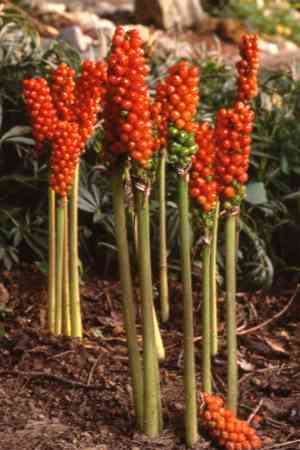
Italian arum multiplies most effectively in Spring via the separation of its tubers, a fairly straightforward technique. Perseverance is crucial, as indications of successful multiplication, like emerging sprouts, might not be visible for several weeks. Guarantee a growing medium with good drainage to foster tuber development.
Optimal Period for Italian Arum Propagation
Propagation Method
Utilize The Tubers
Propagation Period
Spring
Tools Required for Italian Arum Propagation
Gardening gloves
Hand protection during the process, preventing skin irritation from italian arum's sap.
Trowel
Excavating and lifting italian arum's tubers without causing damage.
Sharp knife or hori hori tool
Precise division of tuber sections, each possessing a growth point, ensuring clean cuts for healthy regeneration.
Potting mix
Supplying a well-draining medium, vital for italian arum's roots to prevent decay.
Pots or trays
Receptacles for each tuber cutting to establish roots, ideally with drainage holes to accommodate italian arum's sensitivity to excessive moisture.
Watering can with a fine rose
Gentle water application, crucial to keep italian arum's soil moist but not saturated, fostering healthy root development.
Plant labels and marker
Identification and tracking of propagated italian arum cuttings, ensuring proper care and monitoring of growth progress.
Rooting hormone powder
Encouraging faster root growth on the cut tuber sections of italian arum, boosting the success rate of propagation.
Perlite or vermiculite
Soil amendment to enhance aeration and drainage, critical for italian arum's tuber survival and growth in its initial stages.
Plastic wrap or propagator lid
Creating a humid environment to promote italian arum's root development, while preventing the tubers from becoming overly wet.
How to Propagate Italian Arum?
Propagation Type
Use The Tubers
Difficulty Level
Simple
How to Care for Your Newly Propagated Italian Arum?
How to Care for Your Newly Propagated Italian Arum?
Italian arum thrives in moist, well-drained soil and partial to full shade. Water the plants regularly to maintain consistent soil moisture, especially during dry spells. Fertilize italian arum annually in spring with a balanced fertilizer. Mulch can be reapplied yearly to retain moisture and suppress weeds. During the active growing season, remove yellowed leaves to maintain plant health and appearance. In the dormant season, minimize watering as the plant requires less moisture.
Common Mistakes to Avoid When Propagating Italian Arum
Overwatering
Excessive watering can lead to root rot for italian arum, which prefers well-drained soil. Too much moisture around the roots can create an environment conducive to fungal diseases, impairing the plant's growth and potentially killing it.
Deep planting
Planting the bulbs or corms of italian arum too deeply can prevent them from sprouting, as they require appropriate depth to emerge successfully. Too deep planting can also increase the risk of rot.
Ignoring pests
Neglecting signs of pests such as aphids or spider mites could jeopardize the health of italian arum. These pests can rapidly multiply and cause irreparable damage to the foliage and compromise the plant's vigor.
Overcrowding
Planting italian arum bulbs too close together can lead to competition for nutrients and space, reducing the overall health and bloom potential. It may also promote disease spread due to lack of air circulation.
Tips For Propagating Italian Arum
Soil preparation
Ensuring the soil is well-aerated and fertile before planting italian arum is crucial. Add organic matter to improve soil structure and drainage, which is essential for healthy root development.
Correct depth
Plant the corms of italian arum at the correct depth, which is typically 2-3 times their height. This provides the best conditions for sprouting and root establishment.
Pest monitoring
Regularly inspect italian arum for signs of pest infestations. Early detection and control are key to keeping the plant healthy and ensuring successful propagation.
Spacing
Give italian arum ample space to grow by spacing the bulbs appropriately apart. This helps to ensure adequate nutrient availability for each plant and reduces the risk of disease.



