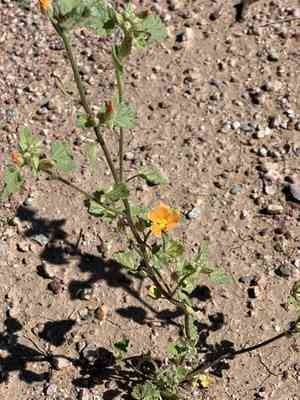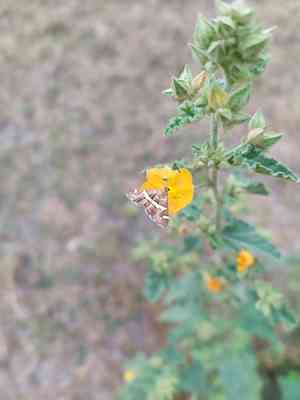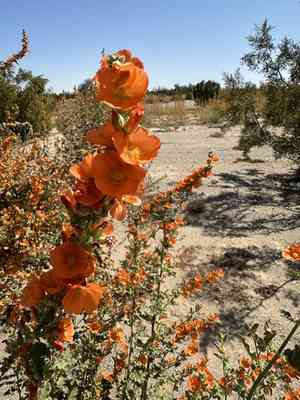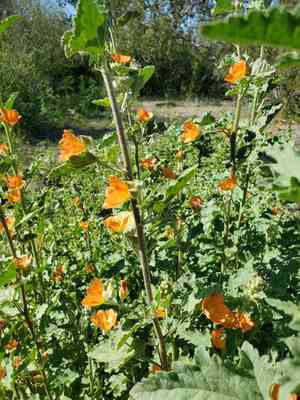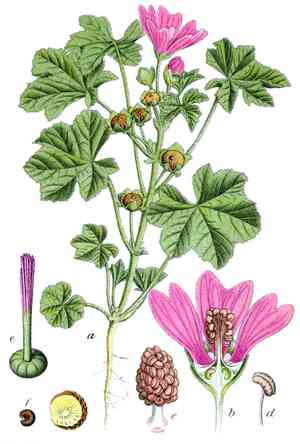
Coulter's globemallow(Sphaeralcea coulteri)

Coulter's globemallow (Sphaeralcea coulteri)

Also known as: Coulter's globemallow, Desert Mallow

Coulter's globemallow (Sphaeralcea coulteri) is a perennial herb notable for its resilience in the arid regions of the Southwestern United States. Characterized by its woody base, it features distinctive round, gray-green leaves and clusters of vibrant orange-red flowers. To survive in desert conditions, this plant has developed several adaptations:

1. **Deep Taproots:** These roots enable the plant to reach deep water reserves.
2. **Fuzzy Leaves:** The fine hairs on its leaves help reduce water evaporation and reflect intense sunlight.
3. **Sunlight Tolerance:** It thrives under strong sunlight, an essential trait for desert flora.
4. **Soil Preference:** It grows best in well-drained soils, ensuring that water does not stagnate around its roots.

Attributes of Coulter's globemallow

Lifespan
Perennial
Plant Height
1 to 3 feet (30 to 90 cm)
Spread
1 to 2 feet (30 to 60 cm)
Leaf Color
Gray-green
Flower Size
1 to 2 inches (2.5 to 5 cm)
Flower Color
Orange

ForwardPlant - Identify plants with a snap

Identify and diagnose plants, get toxicity alerts, and explore safety guides for all types of fungi.

Try for Free

Images of Coulter's globemallow

Coulter's globemallow(Sphaeralcea coulteri)

Quickly Identify Coulter's globemallow

1
Sphaeralcea coulteri can be identified by its hairy, gray-green leaves that are deeply lobed and its distinctive, vibrant orange blossoms. These flowers grow in clusters and have five petals. The plant typically grows in dry, sandy environments.

Scientific Classification of Coulter's globemallow

Phylum
Vascular plants
Class
Dicotyledons
Order
Malvales
Family
Mallow
Genus
Globe mallows
Species
Coulter's globemallow

Planting and Growing of Coulter's globemallow

Care Difficulty
Moderate
Watering Schedule
Every 2 days
Sunlight Requirements
Full sun
Sunshine Duration
4-8 hours
Ideal Temperature
65-80℉
Soil Type
Potting Mix, Peat Mix
Soil pH
6.5-7.5
Fertilizer Type
Balanced
Pruning Season
Spring, Summer
Pruning Area
Branches, Leaves
Pruning Frequency
2 times a year
Repotting Season
Spring
Pot Type
Plastic, Ceramic

water icon How to Water Coulter's globemallow?

For Sphaeralcea coulteri, water approximately 500 milliliters each time. Ensure soil moisture is consistent but not waterlogged. Proper watering lets the roots deeply soak without overly saturating the soil, promoting proper root health.
What are the symptoms of an underwatered Coulter's globemallow?
What should I do if my Coulter's globemallow is not getting enough water?
What are the symptoms of an overwatered Coulter's globemallow?
How to save an overwatered Coulter's globemallow?

sunlight icon What Are the Sunlight Requirements for Coulter's globemallow?

Sunlight Requirements: Full sun
Duration of light: Minimum six hours daily
Sphaeralcea coulteri thrives in full sun, ideally receiving at least six hours of direct light daily. This lighting condition is essential for optimal flowering, robust growth, and physiological health, enhancing both aesthetic and ecological benefits.
How much sunlight does Sphaeralcea coulteri need?
What happens if Sphaeralcea coulteri gets perfect light?
How can I ensure ideal lighting throughout seasonal changes?

temperature icon What Is the Ideal Temperature Range for Coulter's globemallow?

Ideal Temperature: 65 ~ 80℉
Sphaeralcea coulteri thrives in temperatures ranging from 65°F to 80°F. This range facilitates optimal metabolic processes, promoting vigorous growth and flowering. Consistent exposure to this temperature bracket ensures that the plant remains healthy and is able to efficiently carry out photosynthesis and other physiological activities.

soil icon What Soil is Best for Coulter's globemallow?

Soil type: Sandy soil, Loam, Calcareous soil
Soil PH: 6.5 ~ 7.5
Sphaeralcea coulteri thrives in well-draining soil, ensuring that roots have access to both moisture and oxygen. This helps prevent root rot by avoiding water accumulation around the roots. Soil with a sandy or loamy texture provides excellent drainage and aeration. This texture supports robust root development and nutrient uptake, enhancing the overall growth of the plant. This plant does not require overly nutrient-rich soil; moderate fertility is sufficient. Such conditions help avoid excessive vegetative growth, which can lead to weaker stems.

fertilize icon How to Fertilize Coulter's globemallow?

Fertilizer type: Balanced
Sphaeralcea coulteri prefers a balanced fertilizer diluted to half the recommended strength. For liquid fertilizers, using 1 tablespoon per gallon of water is typical. For slow-release fertilizers, follow the package guidelines, and aim not to exceed the equivalent of 1 pound per year for mature plants.

prune icon How to Prune Coulter's globemallow?

Pruning Time: Spring, Summer
Start by removing any dead, damaged, or diseased stems. This prevents the spread of disease and allows the plant to focus energy on healthy growth. Look for blackened or brittle branches as indicators. Trim branches to encourage a neat, bushy form. Cut just above a node or bud to encourage new growth. Ensuring an even shape promotes better light penetration and air circulation throughout the plant. Regularly check the overall size of the plant and keep it within desired limits. Prune back to maintain the desired size, removing about one-third of the oldest stems to rejuvenate the plant. More About Pruning Techniques

propagate icon How to Propagate Coulter's globemallow plant?

Propagate Time: Spring, Early summer
1
Collect ripe seeds from the plant and allow them to dry. Once dried, store them in a cool and dry place until ready for sowing. Scarification may be needed to promote germination.
2
Select a healthy, vigorous stem and cut a section approximately 4-6 inches long. Remove the lower leaves to reduce moisture loss and dip the cut end in rooting hormone for better root development.
3
Use a well-draining soil mix rich in organic matter for both seeds and cuttings. This encourages root growth and ensures the young plants receive necessary nutrients while preventing waterlogging.
More About Propagating Techniques

repot icon How to Repot Coulter's globemallow plant?

Repotting frequency: Every 2-3 years
1
Sphaeralcea coulteri's repotting is best signaled by roots appearing through drainage holes or when growth becomes stunted. Repotting during the growing seasons of spring or summer aids in recovery and root expansion.
2
Select a pot just a size larger than the current one, ensuring it has adequate drainage holes. This prevents root rot and allows for steady growth without overwhelming the plant with excess soil volume.
3
Opt for a well-draining potting mix, rich in nutrients but not overly dense. Such soil caters to the plant's natural preferences and ensures moisture does not linger around the roots, preventing rot.

ForwardPlant - Identify plants with a snap

Find the best spots for them to optimize their health, simply using your phone.

Try for Free