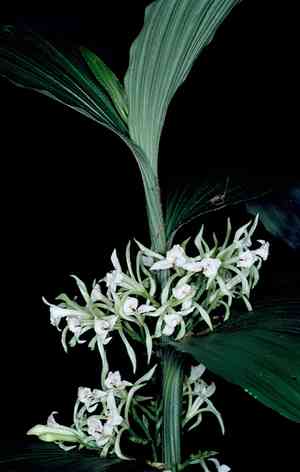
White cinnamon orchid (Corymborkis veratrifolia)
Also known as: None
The white cinnamon orchid (Corymborkis veratrifolia) is a terrestrial orchid, unlike many of its epiphytic relatives that grow on trees. It is not commonly cultivated as an ornamental plant because its dense white flowers have a very brief blooming period. Additionally, the Latin name *veratrifolia* means hellebore-leafed.
In This Article
Attributes of White cinnamon orchid
Lifespan
Perennial
Plant Type
Herb
Plant Height
Up to 1.5 meters
Spread
Approximately 30-50 cm
Leaf Color
Green
Flower Size
Approximately 2-3 cm
Flower Color
White
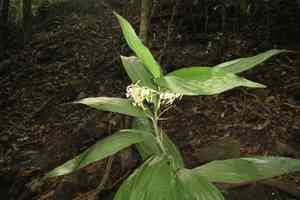
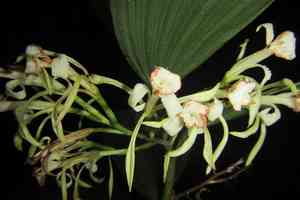
Images of White cinnamon orchid
Quickly Identify White cinnamon orchid
1
Corymborkis veratrifolia can be identified by its tall, slender stature, its leaves which resemble those of the Veratrum (hence its species name \'veratrifolia\'), and its distinctive white flowers arranged in a corymb-like inflorescence. Look for the characteristic lip shape and the plant\'s terrestrial growth habit.
Scientific Classification of White cinnamon orchid
Phylum
Vascular plants
Class
Monocotyledons
Order
Asparagales
Family
Orchid
Genus
Cinnamon orchid
Species
White cinnamon orchid
Planting and Growing of White cinnamon orchid
Care Difficulty
Easy
Watering Schedule
Every 4 days
Sunlight Requirements
Partial sun
Sunshine Duration
4-8 hours
Ideal Temperature
70-85℉
Soil Type
Potting Mix, Peat Mix
Soil pH
6.5-7.5
Fertilizer Type
Balanced
Pruning Season
Spring, Summer
Pruning Area
Branches, Leaves
Pruning Frequency
2 times a year
Repotting Season
Spring
Pot Type
Plastic, Ceramic
 How to Water White cinnamon orchid?
Corymborkis veratrifolia, being a moisture-loving plant, requires around 250 ml of water per watering session. Ensure the soil remains consistently moist but not waterlogged. The amount may slightly vary depending on temperature and humidity levels, but the principle is to mimic its native moist, tropical habitat without drowning the roots.
What are the symptoms of an underwatered White cinnamon orchid?
›
What should I do if my White cinnamon orchid is not getting enough water?
›
What are the symptoms of an overwatered White cinnamon orchid?
›
How to save an overwatered White cinnamon orchid?
›
 What Are the Sunlight Requirements for White cinnamon orchid?
Partial sun or full shade is ideal, balancing light and dark phases which supports healthy growth and maximized flowering potential.
What is the best lighting condition for Corymborkis veratrifolia?
›
Solutions to achieve ideal lighting
›
Benefits of ideal light exposure
›
 What Is the Ideal Temperature Range for White cinnamon orchid?
The ideal temperature range for Corymborkis veratrifolia, a tropical orchid, is between 70°F and 85°F. Within this range, the plant can perform optimal photosynthesis and nutrient absorption, facilitating healthier and robust growth. It closely mimics the natural habitat temperatures, ensuring that the plant's physiological processes remain uninterrupted.
 What Soil is Best for White cinnamon orchid?
Corymborkis veratrifolia thrives in well-drained soil, which prevents waterlogging, a condition that can lead to root rot. This drainage capacity ensures that the roots have access to oxygen, promoting healthy growth and preventing decay. This plant benefits greatly from soil rich in organic matter. It enhances soil fertility and moisture retention, providing the nutrients necessary for robust growth and vibrant flowering. Organic material also encourages beneficial microbial activity. A neutral pH is ideal for Corymborkis veratrifolia, ensuring optimal nutrient absorption. Soil within the pH range of 6.5 to 7.5 allows the plant's roots to efficiently uptake essential minerals, supporting vigorous health and resilience.
 How to Fertilize White cinnamon orchid?
For Corymborkis veratrifolia, it is important to provide a balanced amount of nutrients. Approximately 1/4 strength of a standard liquid orchid fertilizer should suffice, ensuring nutrient delivery without overwhelming the plant. A little goes a long way for ensuring robust growth.
 How to Prune White cinnamon orchid?
Start by determining which parts of Corymborkis veratrifolia require attention, such as dead or damaged leaves. Use a clean, sharp pair of scissors or pruning shears to remove these, making cuts just above the base of the leaf. Enhance the visual appeal by shaping the plant. Trim the tips of longer leaves to promote a fuller appearance, and ensure a balanced look by maintaining symmetry. Seasonal pruning can help maintain its graceful form.
More About Pruning Techniques→
 How to Propagate White cinnamon orchid plant?
1
Fill the seed tray with a moist, sterile potting mix. Gently firm the soil and sprinkle the seeds lightly over the top. Cover them with a thin layer of soil and water gently.
2
Using sterile tools, cut small sections of the plant tissue. Place these in a growing medium within a controlled environment that is free of contaminants to ensure tissue culture success.
3
Carefully remove a mature plant from its pot and separate it into smaller sections. Each section should have roots attached. Re-pot these sections in individual containers for continued growth.
 How to Repot White cinnamon orchid plant?
1
Corymborkis veratrifolia should be repotted when you notice roots growing out of the drainage holes or when the plant becomes top-heavy. These signs indicate that the plant has outgrown its current pot and needs more space to thrive.
2
Select a pot that is just one size larger than the current one, with adequate drainage holes. This prevents waterlogging and subsequent root rot, providing the roots with space to grow without drowning the plant.
3
Opt for a loose orchid mix, which mimics the natural habitat of Corymborkis veratrifolia, ensuring excellent airflow and drainage while retaining the right amount of moisture to nurture the plant.
Learn More About White cinnamon orchid Diseases
Anthracnose
Bacterial Leaf Spot
Bacterial Soft Rot
Bacterial Wilt
Black Spot
Chemical Injury
Crown Gall
Cyst Nematode
Damping-off
Downy Mildew
Drought Stress
Fusarium Wilt
Gray Mold
Leaf Spot
Mosaic
Nutrient Deficiency
Nutrient Toxicity
Powdery Mildew
Root Rot
Root-knot Nematode
Rusts
Sooty Mold
Spider Mites
Temperature Stress
Thrips Damage
White Mold



