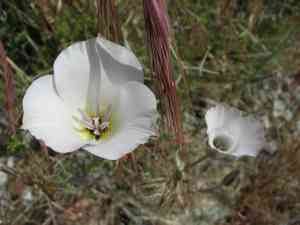
Plain mariposa lily (Calochortus invenustus)
Also known as: Inconspicuous Mariposa Lily
The Mariposa Lily, found in California's mountainous regions, showcases a tri-petal design with colors ranging from pale to deep purple. This wildflower, often spotted in open, rocky areas, features a central gland sometimes fringed with fine hairs. Despite its delicate appearance, it is well-suited to endure the dry summers of its native landscape.
In This Article
Attributes of Plain mariposa lily
Lifespan
Perennial
Plant Type
Herb
Plant Height
20 to 60 cm
Spread
N/A
Leaf Color
Green
Flower Size
2 to 5 cm
Flower Color
White, pink, purple with potential central blotches
Images of Plain mariposa lily

Quickly Identify Plain mariposa lily
1
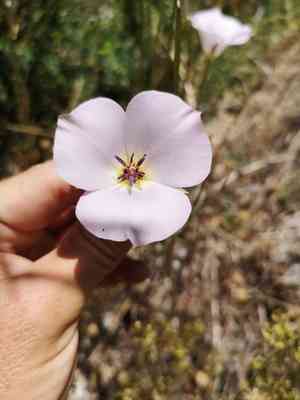
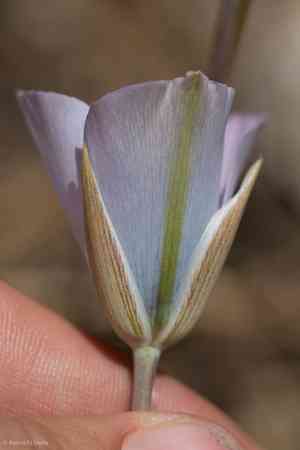
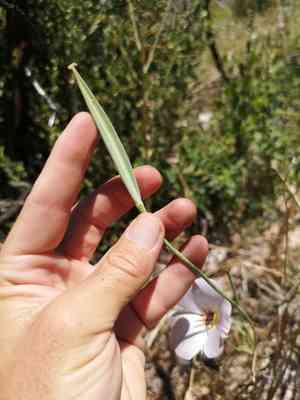
It can be identified by its grass-like basal leaves, erect stems, and bell-shaped flowers with petals that are white, pink, or purple, often with a central blotch of a different color.
Scientific Classification of Plain mariposa lily
Phylum
Vascular plants
Class
Monocotyledons
Order
Liliales
Family
Lily
Genus
Mariposas
Species
Plain mariposa lily
Planting and Growing of Plain mariposa lily
Care Difficulty
Moderate
Watering Schedule
Every 2 days
Sunlight Requirements
Partial sun
Sunshine Duration
4-6 hours
Ideal Temperature
60-75℉
Soil Type
Potting Mix, Peat Mix
Soil pH
6.5-7.5
Fertilizer Type
Balanced
Pruning Season
Spring, Summer
Pruning Area
Branches, Leaves
Pruning Frequency
2 times a year
Repotting Season
Spring
Pot Type
Plastic, Ceramic
 How to Water Plain mariposa lily?
Calochortus invenustus prefers well-drained soil with moderate moisture. The soil should be moistened thoroughly with approximately 200 ml of water per session, allowing the water to reach the depth of the roots. Overwatering should be avoided as the plant is sensitive to excess moisture, which can lead to root rot. The watering principle should focus on maintaining lightly moist soil rather than allowing it to become soggy.
What are the symptoms of an underwatered Plain mariposa lily?
›
What should I do if my Plain mariposa lily is not getting enough water?
›
What are the symptoms of an overwatered Plain mariposa lily?
›
How to save an overwatered Plain mariposa lily?
›
 What Are the Sunlight Requirements for Plain mariposa lily?
Partial sun mimics Calochortus invenustus' natural environment, enhancing its blooming potential and promoting robust growth. This condition is critical for maintaining plant vitality, encouraging a healthy life cycle adaptation.
What is the ideal light condition?
›
How to achieve this ideal lighting?
›
What are the benefits of ideal light conditions?
›
 What Is the Ideal Temperature Range for Plain mariposa lily?
Calochortus invenustus thrives in mild temperature ranges, specifically between 60°F to 75°F. This range ensures active photosynthesis and growth, maintaining plant health and flowering potential. Consistent temperatures within this bracket help the plant avoid stress and promote metabolic activities required for development. Any deviation may affect its growth pattern.
 What Soil is Best for Plain mariposa lily?
Calochortus invenustus thrives in well-drained soil that prevents waterlogging, which can lead to root rot. This requirement ensures the roots receive adequate oxygen and reduces the risk of fungal infections, promoting healthy growth. A nutrient-rich soil provides essential minerals and nutrients that support the plant's growth and flowering. This type of soil enhances the plant's vigor and encourages vibrant blooms, making the garden more visually appealing. Incorporating moderate organic matter into the soil improves its structure and water retention capabilities. It also supports beneficial microbial activity, which contributes to a healthy, resilient root system.
 How to Fertilize Plain mariposa lily?
For Calochortus invenustus, use a balanced liquid fertilizer with a ratio like 10-10-10 during growth periods. Apply about 1/4 teaspoon per gallon of water, ensuring even distribution in the soil. Avoid excessive amounts to prevent root burn.
 How to Prune Plain mariposa lily?
Begin by identifying any dead, diseased, or damaged leaves or stems. Using sharp, sterilized scissors or pruning shears, carefully cut these parts away to prevent the spread of disease and to encourage the growth of healthy tissues. After removing the unhealthy parts, focus on shaping the plant. Calochortus invenustus naturally grows with an interesting shape, but gentle pruning can accentuate its form. Trim any stray stems that disrupt its natural symmetry while being careful not to over-prune. To encourage blooming in the following season, prune spent flowers and seed pods as they appear. This redirects the plant's energy towards root and leaf development, resulting in a more robust plant and more flowers in the next season.
More About Pruning Techniques→
 How to Propagate Plain mariposa lily plant?
1
Collect seeds from a healthy Calochortus invenustus plant once they have matured. Ensure the seeds are dry and free from any mold or damage before proceeding to sow them.
2
Use seed trays filled with a well-draining soil mix. Sow the seeds evenly across the surface and cover lightly with soil. Keep the soil consistently moist but not waterlogged, and place the trays in a warm, sunny location.
3
The division method involves digging up the plant and carefully separating the rhizomes. Use a sharp knife to divide the rhizomes, ensuring each section has a growth point. Replant the sections immediately in well-draining soil.
 How to Repot Plain mariposa lily plant?
1
Calochortus invenustus should be repotted when you notice the roots begin to crowd the pot or come out of the drainage holes. Also, if the plant's growth rate noticeably slows down or it seems to become root-bound, these are strong signals for repotting. Early spring or early autumn are the best times to tackle the task, taking advantage of cooler temperatures and the plant's natural growth cycles.
2
Choosing the right pot involves selecting one that is slightly larger than the current container to allow room for root expansion but not so large that it holds excess water, leading to root rot. Ensure the pot has sufficient drainage holes to prevent waterlogging. The correct pot enhances root health and allows Calochortus invenustus to thrive by promoting optimal soil moisture levels.
3
Opt for well-draining sandy soil that mimics the natural habitat of Calochortus invenustus. Such soil should ideally mix coarse sand and perlite to ensure excellent aeration and drainage, preventing water stagnation that can be detrimental to the bulbs. The right soil composition promotes healthy growth by balancing moisture retention and drainage.
Learn More About Plain mariposa lily Diseases
Anthracnose
Bacterial Leaf Spot
Bacterial Soft Rot
Bacterial Wilt
Black Spot
Chemical Injury
Crown Gall
Cyst Nematode
Damping-off
Downy Mildew
Drought Stress
Fusarium Wilt
Gray Mold
Leaf Curl
Leaf Spot
Mosaic
Nutrient Deficiency
Nutrient Toxicity
Powdery Mildew
Root Rot
Root-knot Nematode
Rusts
Sooty Mold
Spider Mites
Temperature Stress
Thrips Damage
White Mold



